Math Color Pages: A Practical Activity Book Design
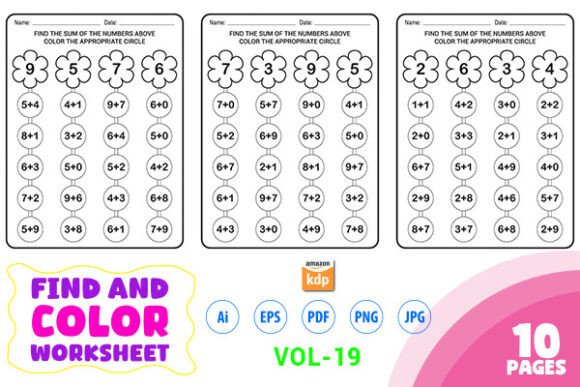
When developing educational resources, the balance between engagement and function is critical. Math Color Pages for Children Homework, specifically the "Find and color number worksheet (VOL-19)," represents a specific approach to early childhood education tools. This is not merely a collection of coloring sheets; it is a structured activity book designed to bridge the gap between arithmetic practice and creative expression. For designers, educators, and content creators in the publishing space, understanding the mechanics of this product offers insights into creating effective, market-ready educational assets.
Design and Functionality in Educational Publishing
The core appeal of Math Color Pages for Children Homework lies in its simplicity and purposeful design. The visual characteristics are intentionally minimal, utilizing a black and white color palette. This choice is pragmatic. It reduces printing costs for the end-user and, more importantly, places the cognitive load on the child's ability to solve a problem, not just follow a color key. The personality of the book is one of clarity and focus. The style is clean, avoiding visual clutter that can overwhelm young learners. The overall appeal is functional—it is a tool that promises a specific outcome: improved math fluency and fine motor skill development through the act of coloring.
This product works best in contexts where practicality is valued over elaborate aesthetics. For a small business owner or blogger creating printables, the Math Color Pages for Children Homework template is a foundational asset. It excels in settings like classroom worksheets, homeschool curricula, after-school activity packs, and educational therapy materials. Its design ensures it translates effectively across different mediums, from a simple home printer to a professional print run. The lack of bleed settings and standard 8.5 x 11-inch dimensions make it universally compatible with common office and publishing equipment.
Strategic Applications for Content Creators
For the entrepreneur or marketer, the value of Math Color Pages for Children Homework extends beyond its immediate educational use. It serves as a case study in creating a scalable digital product. The inclusion of multiple file formats—PDF, PNG, JPEG, AI, and EPS—demonstrates a professional understanding of the end-user's needs. A publisher can immediately bundle the PDF for a direct download shop. A graphic designer can use the editable AI or EPS files to customize the worksheets for a client's brand, perhaps adding a logo or specific school colors to the answer key. This flexibility transforms the product from a static book into a versatile design asset.
Consider the practical guidance for someone evaluating this product. The key is assessing project fit. If you are building a brand identity for an educational startup, the clean, instructional style of these pages provides a consistent visual language. The black and white format allows for easy integration into branded materials—simply add your company's color scheme to headers or borders. When evaluating the included styles, look at the complexity of the math problems and the corresponding illustrations. Do they align with your target age group's developmental stage? The 10-page structure is ideal for a sample pack or a focused, single-skill workbook.
Building a Cohesive Educational Experience
The true strength of Math Color Pages for Children Homework is its contribution to a cohesive learning experience. The interactive element—finding the correct answer and then coloring the associated image—creates a positive feedback loop. This process influences readability of the math concepts by making them tactile and visual. It establishes a clear visual hierarchy: the problem, the solution, and the reward of coloring. For the child, this builds recognition and consistency, associating math practice with a creative, engaging activity.
From a publishing perspective, this model is replicable. The principles applied here—clear instructions, interactive elements, and a clean layout—are the bedrock of successful educational design. Whether you are crafting social media graphics for a tutoring service or designing packaging for a new line of school supplies, the approach seen in Math Color Pages for Children Homework emphasizes user experience and functional design. It proves that effective educational tools don't need to be overly complex; they need to be thoughtfully constructed to guide the learner from problem to solution with clarity and a sense of accomplishment.